

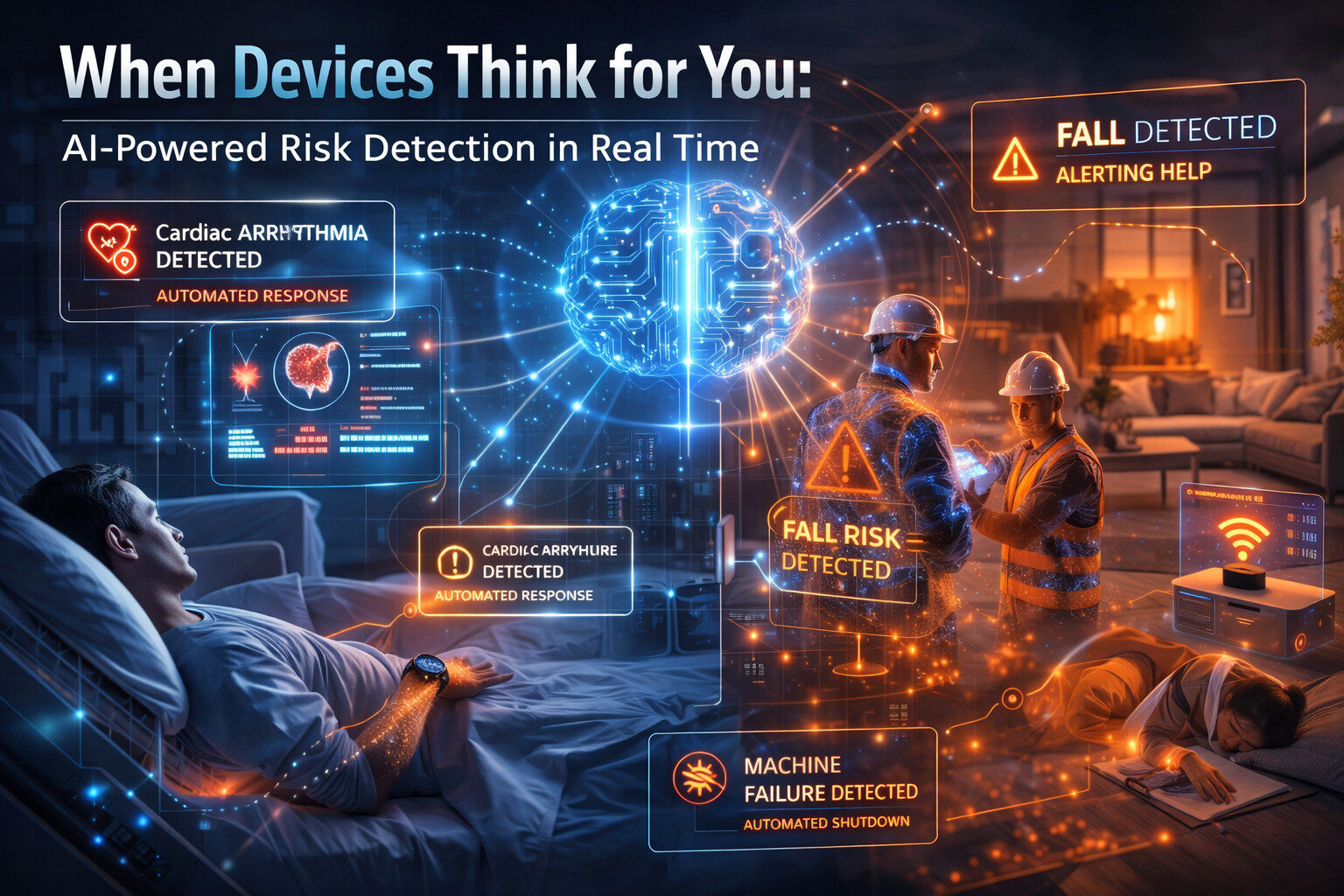
When Devices Think for You: AI-Powered Risk Detection in Real Time

In high-stakes environments—whether in healthcare, industrial operations, or even daily life—timing is everything. A few seconds can mean the difference between prevention and crisis. Traditionally, risk detection has relied on human observation, periodic monitoring, and reactive intervention. But what if systems could identify risks before they fully emerge?
This is precisely where artificial intelligence is beginning to redefine the equation.
AI-powered risk detection systems are enabling a shift from reactive responses to proactive, real-time decision-making—where devices don’t just monitor conditions, but actively interpret and respond to them.
Understanding the Shift: From Monitoring to Intelligence
For years, monitoring systems have been designed to collect and display data—heart rate, temperature, pressure, motion. While useful, these systems depend heavily on human interpretation.
AI changes this dynamic by introducing a layer of intelligence that continuously analyzes incoming data streams, identifies patterns, and detects anomalies in real time.
Instead of simply alerting users when thresholds are crossed, AI-driven systems can recognize subtle deviations that may indicate an impending issue—long before traditional systems would flag a concern.
This transition marks a fundamental shift: devices are no longer passive observers; they are becoming active participants in risk detection.
How It Works: Real-Time Data Meets Predictive Intelligence
At the core of AI-powered risk detection lies the integration of continuous sensing and advanced analytics.
Modern systems leverage a network of sensors—wearables, environmental monitors, or embedded industrial devices—to collect real-time data. This data is then processed through machine learning models trained on historical and contextual datasets.
These models identify correlations and patterns that are often invisible to the human eye. For instance, a combination of slight changes in heart rate variability, oxygen levels, and activity patterns might signal the onset of a medical condition.
In industrial environments, similar models can detect equipment anomalies by analyzing vibration patterns, temperature fluctuations, or operational inconsistencies.
Crucially, these systems are designed to operate in real time. They do not merely analyze past data—they continuously learn, adapt, and refine their predictions as new data flows in.
Real-World Applications: Preventing Risks Before They Escalate
The implications of real-time risk detection are already being realized across multiple domains.
In healthcare, AI-powered wearables and monitoring systems can detect early signs of medical emergencies such as cardiac events, respiratory distress, or neurological anomalies. This enables timely intervention, often before symptoms become severe.
In workplace safety, particularly in industries like manufacturing, construction, and mining, AI systems can monitor both human and machine behavior. They can identify unsafe conditions, predict equipment failures, and even detect fatigue or stress in workers—reducing the likelihood of accidents.
Consumer applications are also emerging. Smart home systems can detect unusual activity patterns, such as falls in elderly individuals or environmental hazards like gas leaks, and trigger alerts or automated responses.
Across these scenarios, the common thread is clear: risk detection is becoming faster, smarter, and more predictive.
The Innovation and IP Landscape
As AI-powered risk detection systems evolve, they are driving significant innovation—and with it, a growing focus on intellectual property.
Patents in this space are increasingly centered around:
- Multi-sensor data integration and fusion
- Real-time anomaly detection algorithms
- Predictive modeling techniques
- Automated response mechanisms
What makes this domain particularly complex from an IP perspective is the layered nature of innovation. A single solution may involve hardware components, data processing pipelines, and proprietary AI models—all of which can be protected through different IP strategies.
Moreover, access to high-quality data is emerging as a competitive differentiator. Companies are not only protecting algorithms but also building defensible advantages around data acquisition and training methodologies.
This creates a dynamic and competitive landscape where technological advancement and IP strategy are deeply intertwined.
Looking Ahead: Toward Autonomous Safety Systems
The trajectory of AI-powered risk detection points toward increasingly autonomous systems—where detection, decision-making, and response are tightly integrated.
In the future, devices may not only identify risks but also take immediate corrective actions. A wearable could alert emergency services automatically, an industrial system could shut down malfunctioning equipment, or a smart environment could adjust conditions to prevent harm.
However, as these systems become more autonomous, new challenges will emerge. Ensuring accuracy, minimizing false positives, and addressing privacy concerns will be critical to widespread adoption.
Despite these challenges, the direction is clear. We are moving toward a world where safety is not just monitored—it is actively managed by intelligent systems operating in real time.
In such a world, the role of technology extends beyond assistance. It becomes a silent guardian—constantly analyzing, predicting, and acting—often before we even realize there is a risk to address.