

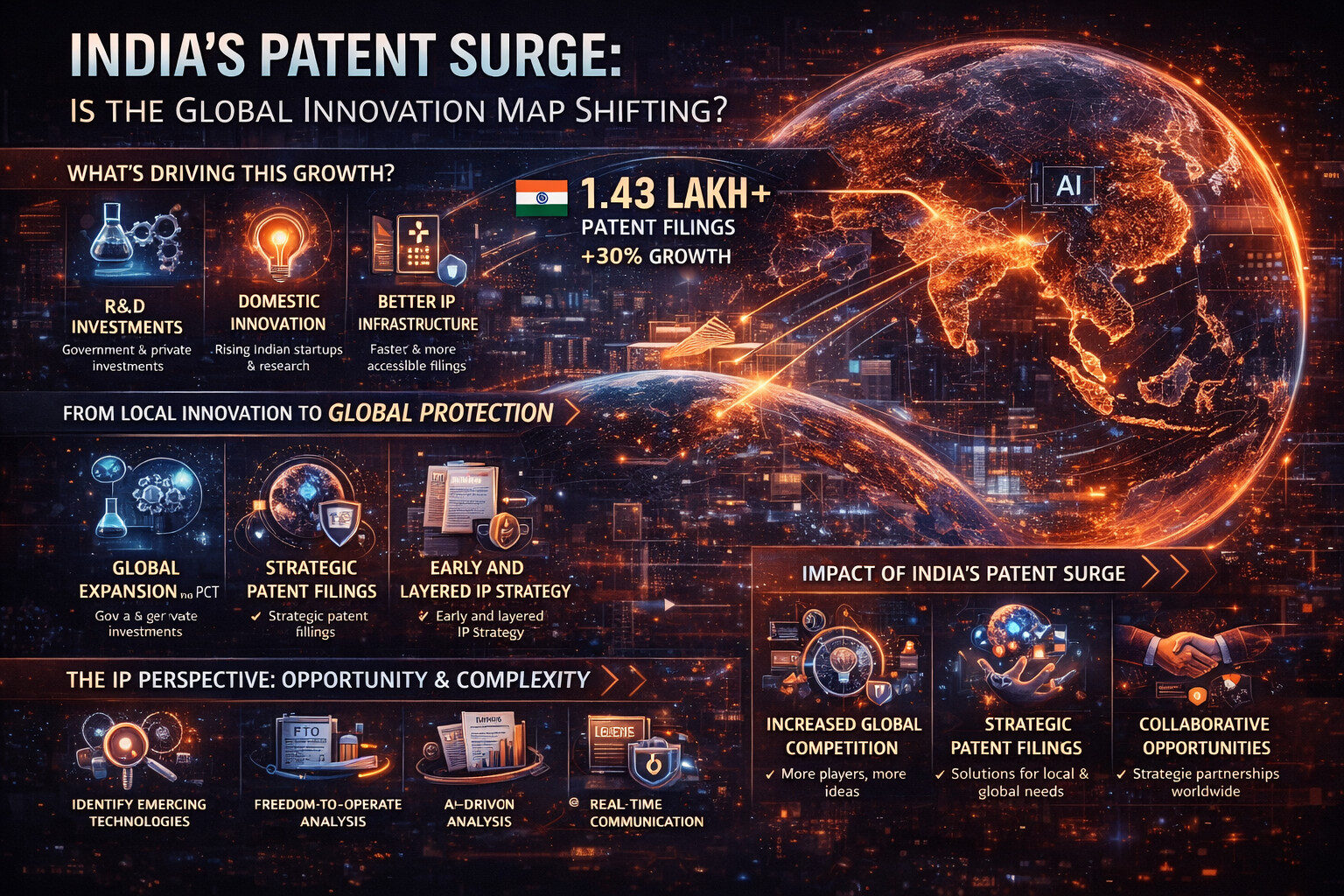
India’s Patent Surge: Is the Global Innovation Map Shifting?

For years, global innovation leadership has been concentrated in a handful of regions—most notably the United States, Europe, and China. Patent filings, often used as a proxy for innovation strength, have historically reflected this distribution.
But recent trends suggest a shift may be underway.
India has witnessed a significant rise in patent filings, crossing new milestones with strong year-on-year growth driven increasingly by domestic innovators. This is not just a numerical increase—it signals a deeper transformation in how and where innovation is being created, protected, and scaled.
The question is no longer whether India is growing as an innovation hub. The real question is: what does this mean for the global innovation landscape?
Understanding the Surge: What’s Driving India’s Patent Growth?
The rise in patent filings in India is the result of multiple converging factors.
First, there has been a notable increase in R&D investments, both from private enterprises and government-backed initiatives. Programs aimed at fostering innovation—particularly in sectors like biotechnology, AI, electronics, and sustainability—have created a fertile environment for new inventions.
Second, there is a clear shift toward domestic participation. Historically, a large portion of patent filings in India came from foreign entities. Today, Indian companies, startups, and academic institutions are contributing a growing share, indicating a strengthening internal innovation ecosystem.
Third, improvements in the IP infrastructure—including faster examination timelines, digitization of processes, and increased awareness—have made patenting more accessible and efficient.
Together, these factors are transforming India from a consumption-driven market into a creation-driven innovation economy.
How It Works: From Local Innovation to Global Protection
As patent activity increases, so does the sophistication of IP strategy.
Indian innovators are not only filing domestically but are also expanding into international markets through mechanisms such as the Patent Cooperation Treaty (PCT). This allows them to secure early priority while evaluating global commercialization opportunities.
At the same time, companies are becoming more strategic in how they structure their filings:
- Protecting core technologies early
- Building layered patent portfolios
- Aligning filings with business and market expansion plans
This evolution reflects a broader understanding that patents are not just legal protections—they are strategic assets that enable scaling, investment, and competitive positioning.
Real-World Impact: A More Distributed Innovation Ecosystem
The implications of India’s patent surge extend beyond national boundaries.
A rise in domestic filings suggests that innovation is becoming more geographically distributed. Instead of being concentrated in traditional hubs, new centers of innovation are emerging—bringing fresh perspectives, cost efficiencies, and localized problem-solving approaches.
This has several consequences:
- Increased Global Competition
More players entering the innovation landscape means greater competition across industries - Diverse Innovation Pipelines
Solutions are increasingly tailored to regional challenges, leading to more varied technological advancements - Collaborative Opportunities
Global companies are more likely to partner with Indian innovators for co-development and market expansion
In essence, the innovation ecosystem is becoming more dynamic—and more interconnected.
The IP Perspective: Opportunity and Complexity
From an intellectual property standpoint, this surge introduces both opportunities and challenges.
On one hand, increased filings indicate a rich and expanding innovation pipeline. For businesses, this creates opportunities to:
- Identify emerging technologies early
- Engage in strategic partnerships
- Explore licensing and acquisition opportunities
On the other hand, a denser patent landscape also brings complexity:
- Higher risk of overlapping claims
- Increased need for freedom-to-operate (FTO) analyses
- Greater importance of robust patent landscaping
For organizations operating globally, this means that India is no longer a peripheral consideration—it is becoming a key jurisdiction in IP strategy.
Looking Ahead: Redrawing the Innovation Map
India’s rise in patent activity is not an isolated trend—it is part of a broader shift toward a more distributed and competitive global innovation landscape.
As domestic ecosystems mature and international strategies evolve, the lines that once defined innovation leadership are beginning to blur. Leadership is no longer tied to geography alone—it is defined by who can innovate, protect, and scale effectively.
For businesses, innovators, and IP professionals, this shift presents both a challenge and an opportunity. Navigating this evolving landscape will require not only technical expertise, but also strategic foresight.
Because in the emerging world of innovation, the map is being redrawn—and those who understand where it is heading will be best positioned to lead.