

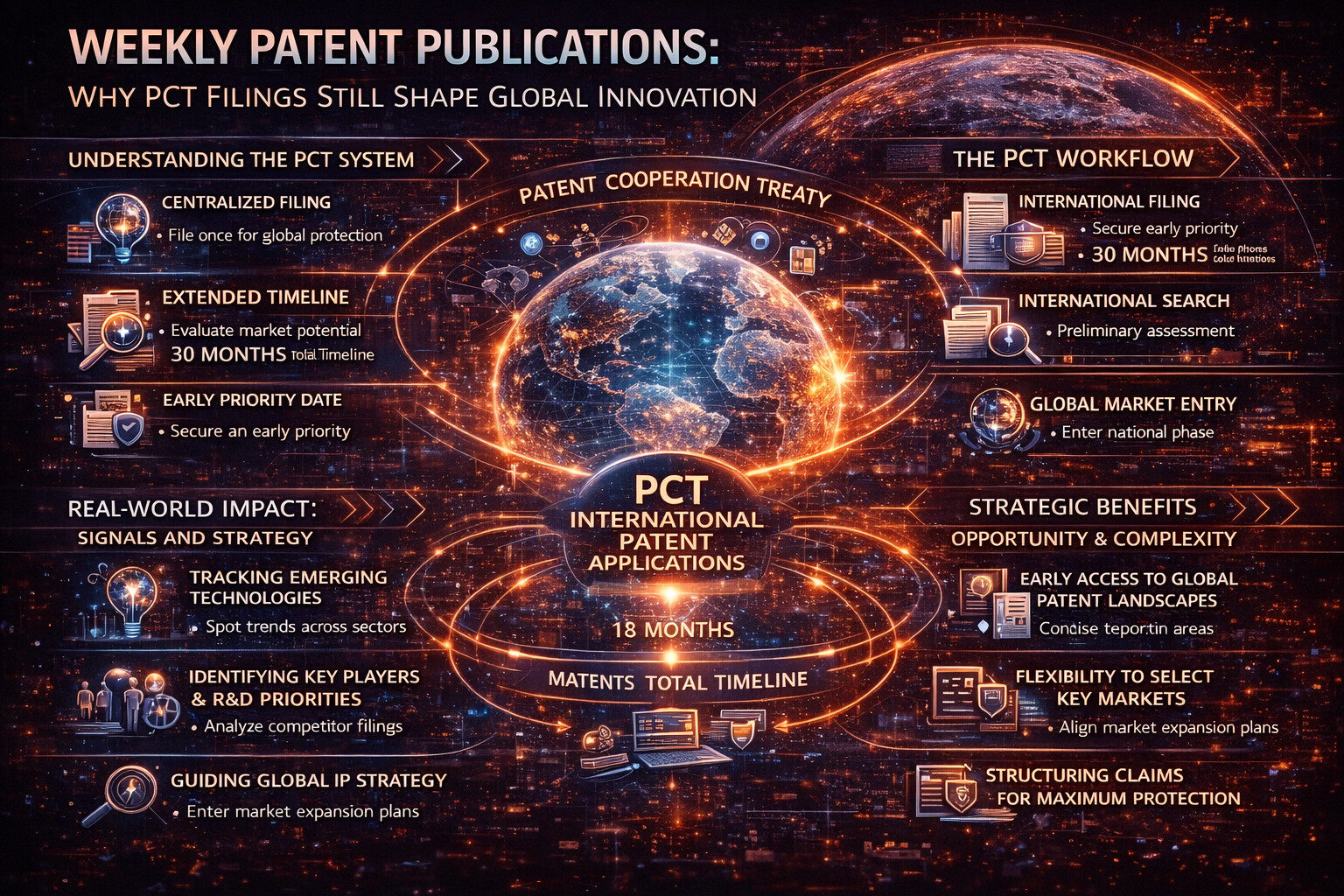
Weekly Patent Publications: Why PCT Filings Still Shape Global Innovation

Every week, thousands of patent applications are published across jurisdictions—quietly revealing the next wave of technological advancement. Among these, filings under the Patent Cooperation Treaty (PCT) stand out as a unique signal of global intent.
While individual national filings reflect localized protection strategies, PCT applications represent something broader: a deliberate move toward international innovation and commercialization.
In an increasingly globalized technology landscape, understanding the role of PCT filings is not just relevant—it is essential. Because long before products reach markets, PCT publications offer a glimpse into where innovation is headed, and who is positioning to lead it.
Understanding the PCT System: A Gateway to Global Protection
The Patent Cooperation Treaty was designed to simplify the process of seeking patent protection across multiple countries.
Instead of filing separate applications in each jurisdiction from the outset, innovators can file a single international application, securing an early priority date while keeping options open for global expansion.
This approach offers several advantages:
- Centralized filing process
- Extended timeline for decision-making
- Early visibility into international patent landscapes
For companies operating in fast-moving industries, this flexibility is critical. It allows them to evaluate commercial potential, refine strategies, and allocate resources before committing to specific markets.
How It Works: From Filing to Global Entry
A PCT application follows a structured lifecycle.
After the initial filing, the application undergoes an international search, which identifies relevant prior art and provides a preliminary assessment of patentability. This is followed by publication—typically 18 months from the priority date—making the invention publicly accessible.
At this stage, the application enters what is often referred to as the international phase, where innovators can:
- Assess market opportunities
- Refine claims based on search reports
- Engage in strategic planning for national filings
Eventually, the application moves into the national phase, where protection is sought in selected jurisdictions.
This phased approach provides both time and insight, enabling more informed decision-making.
Real-World Applications: Strategic Signaling and Market Positioning
PCT filings serve purposes beyond legal protection—they act as strategic signals.
For competitors, investors, and analysts, newly published PCT applications offer early visibility into:
- Emerging technologies
- R&D priorities of key players
- Potential areas of future competition
For example, a surge in PCT filings related to a specific domain—such as AI-driven healthcare or sustainable energy solutions—often indicates where the next wave of innovation is building.
For companies, filing through the PCT route signals intent to scale globally, rather than remain confined to a single market.
The IP Perspective: Navigating Complexity and Opportunity
From an intellectual property standpoint, PCT filings introduce both significant opportunities and notable complexities. On one hand, they provide early access to global patent landscapes, enabling organizations to identify emerging technologies and monitor innovation trends at an early stage. They also allow businesses to track competitor activity more effectively, offering valuable insights into strategic directions and potential areas of competition. Additionally, the PCT system offers flexibility in market entry, giving innovators time to assess commercial potential before committing to specific jurisdictions.
On the other hand, this global approach comes with its own set of challenges. Managing costs across multiple jurisdictions can become increasingly complex, particularly as applications move into the national phase. Organizations must also navigate varying legal requirements across different countries, which can impact prosecution strategies and timelines. Ensuring consistency in claim scope and strategy across regions is another critical consideration, as inconsistencies can weaken overall protection.
For IP professionals, analyzing PCT publications plays a crucial role in activities such as patent landscaping, freedom-to-operate (FTO) analysis, and competitive intelligence. In many ways, PCT data functions as a global radar for innovation—providing early signals that help organizations anticipate trends, assess risks, and make informed strategic decisions.
The Strategic Dimension: Timing, Selection, and Positioning
Success in leveraging the PCT system depends on strategic decision-making.
Organizations must consider:
- When to file to secure optimal priority
- Where to enter during the national phase
- How to structure claims for maximum protection
These decisions are closely tied to business objectives, including market expansion, licensing opportunities, and competitive positioning.
In highly competitive sectors, early and well-structured PCT filings can create significant advantages—establishing a foundation for long-term IP strength.
Looking Ahead: PCT as a Blueprint for Global Innovation
As innovation becomes increasingly global, the relevance of the PCT system continues to grow.
It provides a framework that aligns with modern innovation cycles—where technologies are developed, tested, and scaled across borders. At the same time, it offers transparency, allowing stakeholders to track and analyze emerging trends.
For innovators, PCT filings are more than procedural steps—they are strategic tools that shape how technologies move from concept to global impact.
In the years ahead, the ability to navigate and interpret PCT publications will be a key differentiator for organizations seeking to stay ahead of the curve.
Because in the global race for innovation, those who understand early signals—and act on them—will be best positioned to lead.