

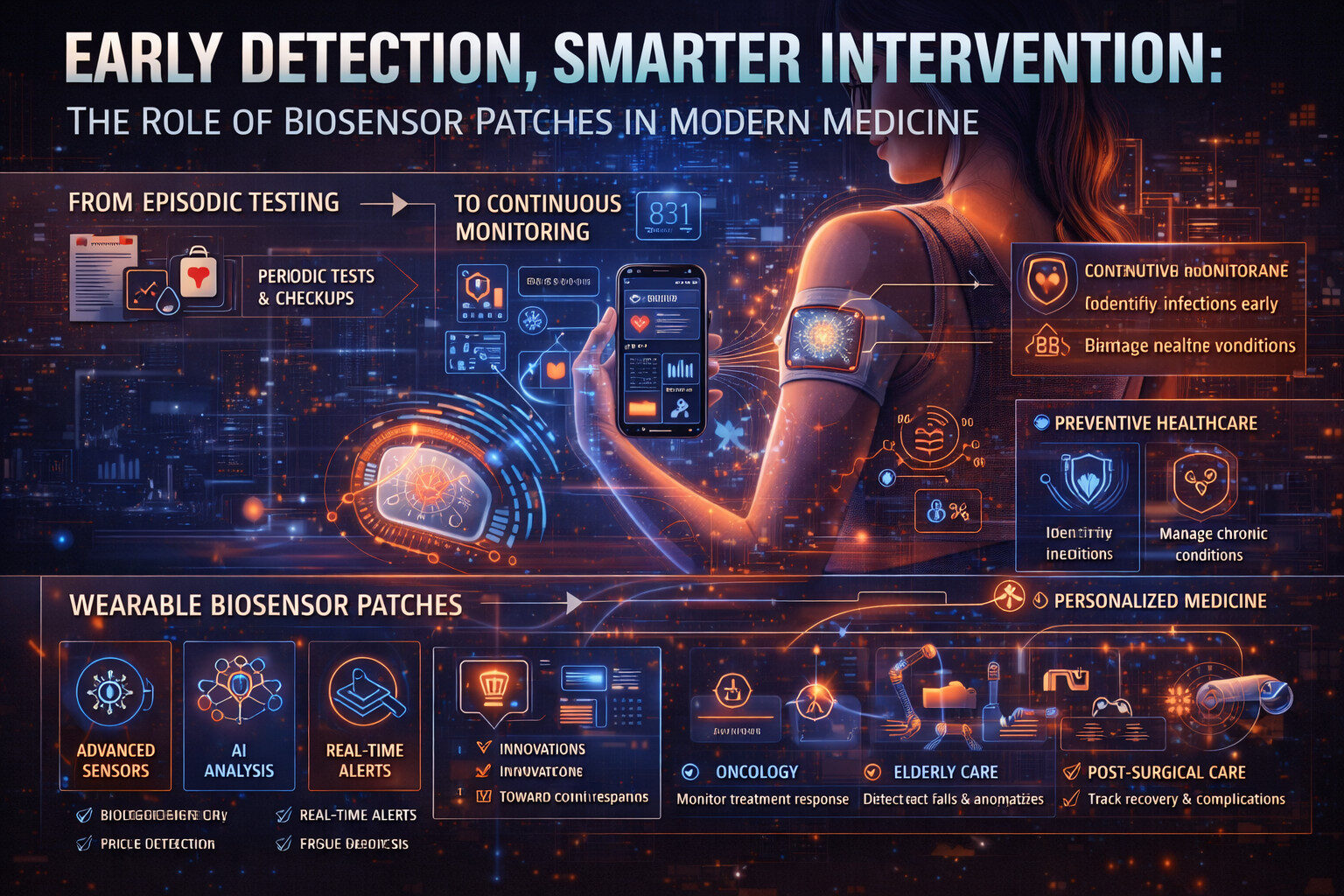
Early Detection, Smarter Intervention: The Role of Biosensor Patches in Modern Medicine

Healthcare has long been built around a reactive model—patients seek care when symptoms appear, diagnoses follow, and treatment begins. While this approach has saved countless lives, it often means that diseases are detected only after they have progressed.
But what if healthcare could shift from reacting to illness to anticipating it?
This is the promise of wearable biosensor patches—thin, flexible devices designed to continuously monitor physiological signals and detect early signs of disease. Powered by advances in sensing technologies and artificial intelligence, these patches are redefining how and when medical intervention occurs.
Understanding the Shift: From Episodic Care to Continuous Monitoring
Traditional healthcare relies on periodic measurements—check-ups, lab tests, and imaging performed at specific intervals. While effective, these snapshots provide only limited insight into a patient’s health over time.
Biosensor patches introduce a fundamentally different approach: continuous monitoring.
Applied directly to the skin, these devices track parameters such as heart rate, temperature, biochemical markers, and even subtle physiological changes. Instead of isolated data points, they generate a continuous stream of information—offering a more comprehensive view of a patient’s health.
This shift enables earlier detection of abnormalities, often before symptoms become noticeable.
How It Works: Sensing, Data, and Intelligence
At the core of biosensor patches lies a combination of advanced materials, microelectronics, and data analytics.
These patches are typically designed to be lightweight, flexible, and biocompatible, allowing them to conform comfortably to the body. Embedded within them are sensors capable of detecting various signals—ranging from electrical activity to chemical changes.
The collected data is then transmitted to connected devices, such as smartphones or cloud-based platforms, where it is analyzed using AI algorithms.
These algorithms identify patterns, detect anomalies, and generate insights in real time. For example, a patch monitoring skin temperature and biochemical markers might detect early signs of inflammation or infection. Similarly, changes in physiological patterns could indicate the onset of chronic conditions.
By combining sensing with intelligence, biosensor patches transform raw data into actionable insights.
Real-World Applications: Preventive and Personalized Healthcare
The potential applications of biosensor patches span a wide range of medical scenarios.
In preventive healthcare, these devices can identify early warning signs of diseases such as infections, cardiovascular conditions, or metabolic disorders—enabling timely intervention.
In chronic disease management, continuous monitoring allows for more precise tracking of patient conditions. This supports personalized treatment plans and helps reduce hospital visits.
Biosensor patches are also gaining traction in areas such as:
- Oncology, for monitoring treatment response
- Post-surgical care, for tracking recovery and detecting complications
- Elderly care, for identifying falls or health anomalies in real time
In each case, the focus is the same: improving outcomes by acting earlier and more accurately.
The Innovation Landscape: Where Healthcare Meets IP
As biosensor technologies advance, they are becoming a focal point for innovation—and intellectual property.
Patent activity in this space is growing rapidly, covering areas such as:
- Flexible and stretchable sensor materials
- Methods for detecting and analyzing biological signals
- Integration with AI-driven analytics platforms
- Communication systems for real-time data transmission
These innovations are inherently multidisciplinary, combining elements of materials science, electronics, software, and healthcare.
From an IP perspective, this creates opportunities—and challenges. Companies must navigate complex patent landscapes while protecting both hardware and software components. In many cases, proprietary data and algorithms are also safeguarded through trade secrets.
This layered approach to IP reflects the strategic importance of biosensor technologies in the future of healthcare.
Looking Ahead: Toward Invisible Healthcare
The evolution of biosensor patches points toward a broader vision: healthcare that is continuous, unobtrusive, and deeply integrated into everyday life.
As these devices become more advanced, they may evolve into systems that not only detect risks but also trigger automated responses—alerting healthcare providers, adjusting treatments, or even integrating with therapeutic devices.
At the same time, challenges such as data privacy, regulatory approval, and system reliability must be addressed to ensure widespread adoption.
Despite these hurdles, the direction is clear. Healthcare is moving away from episodic interactions and toward a model where monitoring and intervention are seamlessly embedded into daily life.
In this future, the most powerful medical tools may not be found in hospitals—but worn quietly on the skin, continuously working to detect, predict, and protect.
Because when it comes to health, the earlier we act, the better the outcome—and biosensor patches are bringing us closer than ever to that ideal.