

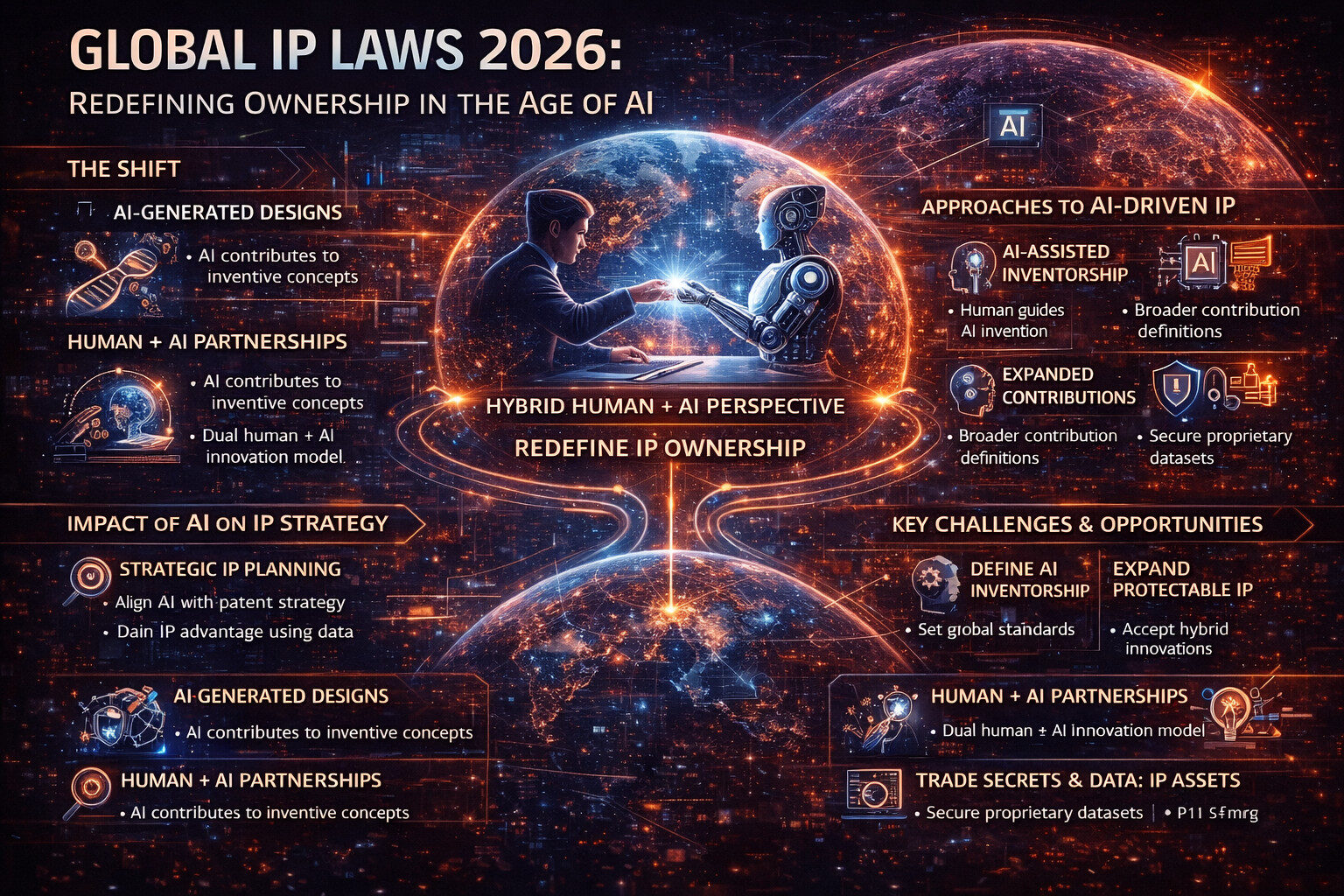
Global IP Laws 2026: Redefining Ownership in the Age of AI

For decades, intellectual property systems have operated on a fundamental assumption: innovation is a human endeavor. Patents, copyrights, and other forms of protection have been designed around the idea that inventions originate from human ingenuity and creativity.
But artificial intelligence is beginning to challenge that assumption.
As AI systems become more capable—generating designs, optimizing processes, and even contributing to inventive concepts—the question of ownership is becoming increasingly complex. Who owns an invention created with significant AI involvement? How should contributions be attributed? And more importantly, how should IP laws evolve to reflect this new reality?
In 2026, these questions are no longer theoretical. They are actively reshaping global IP frameworks.
Understanding the Shift: From Human-Centric to Hybrid Innovation
Traditional IP laws are built on clear definitions of inventorship and authorship. A human inventor creates, and the law assigns rights accordingly.
However, AI-driven innovation introduces a hybrid model, where outcomes are often the result of collaboration between human input and machine-generated insights.
For example:
- An AI system may identify a novel molecular structure for drug development
- A machine learning model may optimize an engineering design beyond human intuition
- Generative systems may propose solutions that humans refine and implement
In such cases, innovation is no longer purely human or purely machine—it is a combination of both.
This shift is forcing legal systems to reconsider how ownership is defined and attributed.
How It Works: Emerging Approaches to AI-Driven IP
Different jurisdictions are beginning to explore ways to address AI’s role in innovation.
While most systems still require a human inventor for patent eligibility, there is growing recognition of AI’s contribution. As a result, new approaches are emerging:
- Human-Centric Attribution with AI Assistance
Assigning inventorship to the human who directed or utilized the AI system - Expanded Definitions of Inventive Contribution
Recognizing the role of AI in generating or refining ideas, even if ownership remains human-based - Hybrid Ownership Models (Emerging Concept)
Exploring frameworks where AI contributions are formally acknowledged within the IP structure
At the same time, organizations are increasingly relying on trade secrets and data protection to safeguard AI-driven innovations that may not fit neatly within existing patent frameworks.
Real-World Impact: Innovation, Ownership, and Competition
The evolution of IP laws in response to AI is already influencing how innovation is developed and commercialized.
For businesses, the implications are significant:
- Strategic IP Planning
Companies must carefully structure how AI is used in the innovation process to ensure patent eligibility - Data as a Competitive Asset
Proprietary datasets and training methodologies are becoming critical components of IP strategy - Increased Complexity in Ownership
Collaborative environments involving AI, developers, and organizations require clear agreements on rights and attribution
At a broader level, these changes are shaping competition. Organizations that understand how to navigate AI-related IP challenges will be better positioned to secure and defend their innovations.
The IP Perspective: Challenges and Opportunities
The integration of AI into IP systems presents both challenges and opportunities.
Challenges include:
- Defining inventorship in AI-assisted inventions
- Addressing patent eligibility for algorithm-driven outputs
- Ensuring consistency across jurisdictions
Opportunities include:
- Expanding the scope of protectable innovations
- Encouraging new forms of collaboration between humans and machines
- Driving the evolution of IP frameworks to match technological progress
For IP professionals, this is a period of transition—requiring not only legal expertise but also a deep understanding of how AI technologies function.
Looking Ahead: Toward Adaptive IP Frameworks
As AI continues to advance, IP systems will need to become more adaptive.
Future frameworks may:
- Provide clearer guidelines on AI-assisted inventorship
- Introduce standardized approaches across jurisdictions
- Balance protection with accessibility to ensure continued innovation
At the same time, the role of strategy will become even more critical. Organizations will need to align their innovation processes with evolving legal standards—ensuring that their inventions are not only groundbreaking, but also protectable.
Conclusion: Redefining Ownership in a New Era
The rise of AI is not just transforming technology—it is redefining the very concept of ownership.
In a world where innovation is increasingly collaborative—between humans and machines—the boundaries of IP must evolve accordingly. The challenge lies in creating systems that recognize new forms of contribution while maintaining clarity, fairness, and enforceability.
As global IP laws continue to adapt, one thing is clear: the future of ownership will not be defined solely by who creates, but by how creation itself is understood.
And in that future, the intersection of AI and IP will be one of the most important frontiers shaping innovation worldwide.