

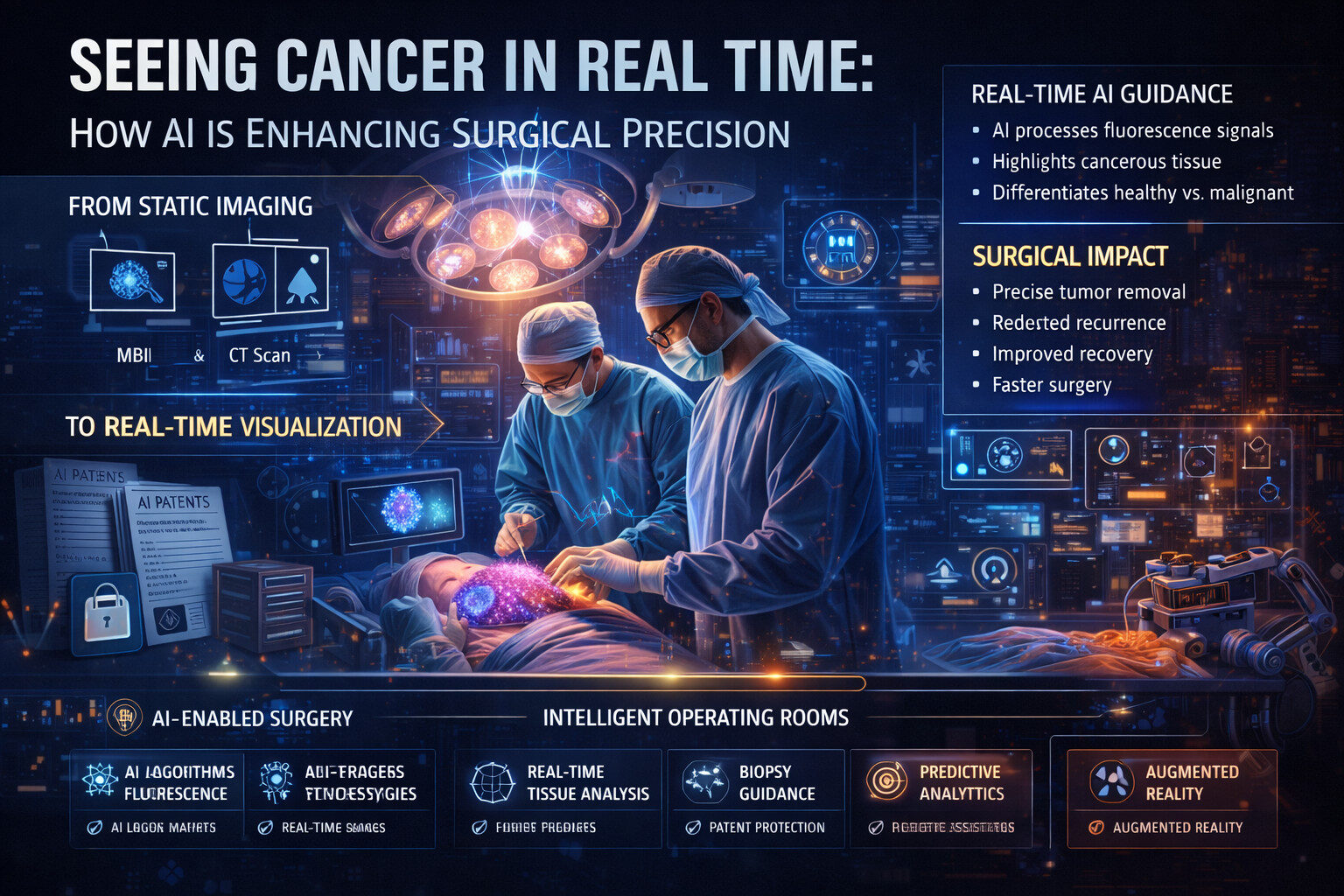
Seeing Cancer in Real Time: How AI is Enhancing Surgical Precision

For decades, one of the biggest challenges in cancer surgery has not been removing tumors—but removing them accurately. Surgeons must strike a delicate balance: eliminate all cancerous tissue while preserving as much healthy tissue as possible. Even with advanced imaging technologies, distinguishing between malignant and healthy tissue during surgery has remained a complex and often uncertain task.
But what if surgeons could see cancer as clearly as they see anatomy?
With the integration of artificial intelligence (AI) into surgical imaging, that possibility is quickly becoming a reality. AI-powered systems are enabling real-time visualization of cancerous tissues, fundamentally changing how surgical decisions are made in the operating room.
Understanding the Shift: From Static Imaging to Real-Time Insight
Traditional imaging methods—such as MRI, CT scans, and biopsies—play a crucial role in preoperative planning. However, once surgery begins, surgeons often rely on visual cues and experience to guide tissue removal.
AI is transforming this process by introducing dynamic, real-time insights during surgery.
By combining advanced imaging techniques with machine learning algorithms, these systems can analyze tissue characteristics on the spot. Instead of relying solely on preoperative data, surgeons can now access live feedback that highlights suspicious or cancerous regions.
This shift moves surgical decision-making from estimation to data-driven precision.
How It Works: AI Meets Fluorescence Imaging
One of the most promising approaches in this space involves AI-enhanced fluorescence imaging.
During surgery, patients may be administered specialized fluorescent agents that bind to cancer cells. When exposed to specific wavelengths of light, these agents cause cancerous tissues to glow, making them distinguishable from surrounding healthy tissue.
AI algorithms then analyze these fluorescence signals in real time. By processing patterns in intensity, distribution, and structure, the system can:
- Identify tumor boundaries
- Detect residual cancer cells
- Differentiate between tissue types
Importantly, AI enhances the accuracy of this process by reducing noise and improving signal interpretation—helping surgeons make more confident decisions.
Real-World Applications: Transforming Surgical Outcomes
The integration of AI into surgical imaging is already demonstrating significant impact across multiple cancer types.
In oncology procedures such as brain, breast, and gastrointestinal surgeries, precise tumor removal is critical. AI-assisted imaging helps ensure that cancerous tissues are fully removed while minimizing damage to surrounding areas.
This has several benefits:
- Reduced recurrence rates due to more complete tumor removal
- Improved patient recovery by preserving healthy tissue
- Shorter surgery times through clearer decision-making
Beyond tumor removal, these systems are also being explored for use in biopsy guidance, enabling more accurate sampling of suspicious tissues.
The Innovation Landscape: Where Technology Meets IP
As AI-powered surgical imaging advances, it is driving significant innovation—and with it, increasing patent activity.
Companies and research institutions are actively developing and protecting technologies related to:
- AI-based image processing and enhancement
- Real-time tissue classification algorithms
- Integration of imaging systems with surgical tools
- Fluorescent marker detection and analysis
This has created a competitive IP landscape where multiple players are working to secure foundational technologies.
From a patent strategy perspective, these innovations are particularly valuable because they sit at the intersection of hardware, software, and clinical application. Protecting such systems often requires multi-layered IP approaches, combining patents with proprietary data and algorithms.
For stakeholders, this underscores the importance of aligning technological development with strong IP strategies—ensuring both innovation and ownership.
Looking Ahead: Toward Intelligent Operating Rooms
The future of surgery is not just about better tools—it is about smarter systems.
As AI continues to evolve, surgical environments are expected to become increasingly intelligent. Real-time imaging may be combined with predictive analytics, robotic assistance, and augmented reality overlays—creating a fully integrated decision-support ecosystem.
In such settings, surgeons will not work alone; they will be supported by systems that continuously analyze, guide, and enhance their actions.
While challenges remain—such as regulatory approval, system integration, and data standardization—the trajectory is clear. AI is moving from the periphery of surgical care to its very core.
In the end, the goal is simple yet profound: to make cancer visible in ways it never has been before—and in doing so, to enable surgeries that are not just effective, but truly precise.