

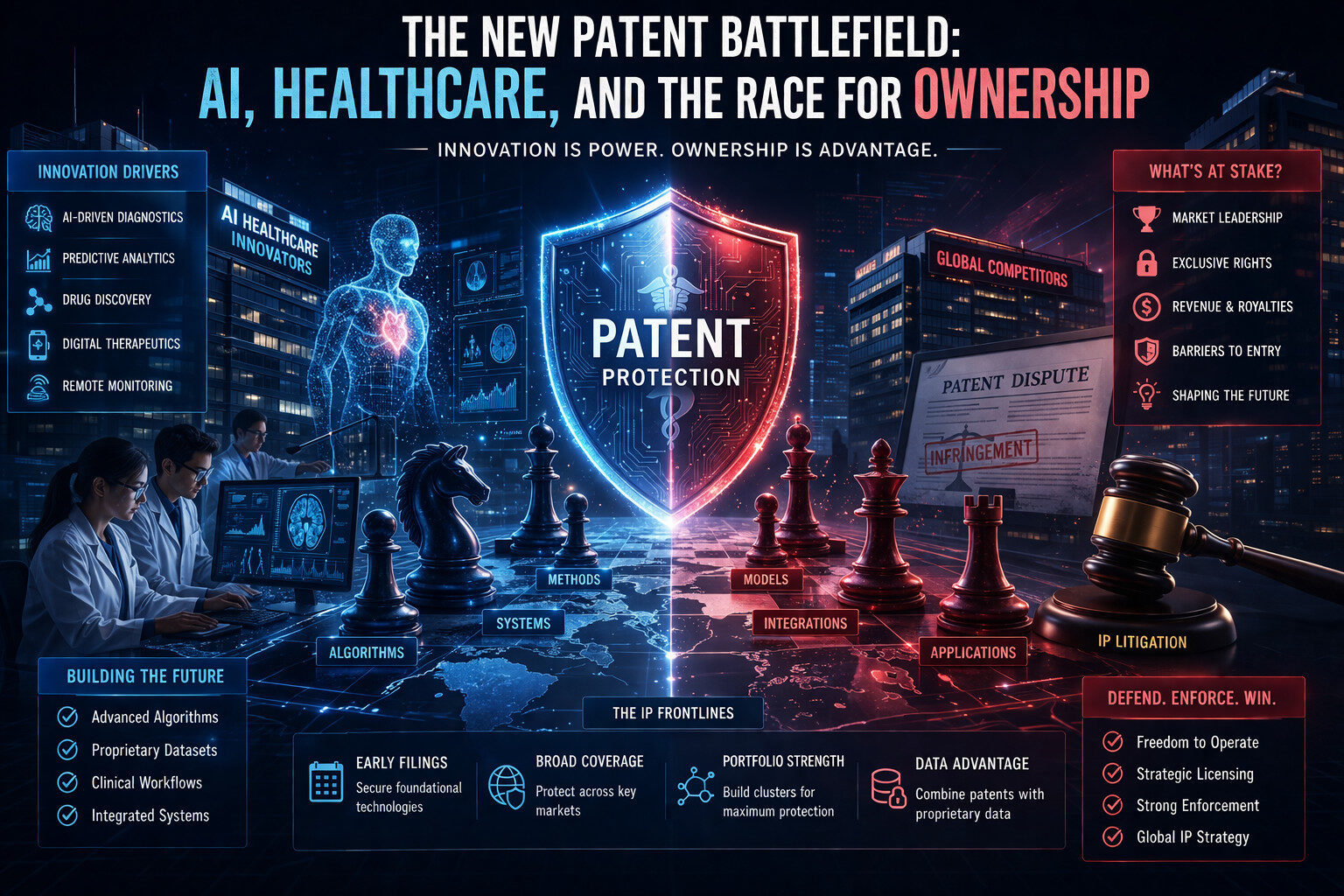
The New Patent Battlefield: AI, Healthcare, and the Race for Ownership

Artificial intelligence is redefining healthcare at an unprecedented pace. From early disease detection to personalized treatment planning, AI-driven systems are unlocking capabilities that were once considered futuristic. But as innovation accelerates, so does competition—not just in developing these technologies, but in owning them.
Behind every breakthrough lies a parallel race: the race to secure intellectual property. In today’s landscape, AI-powered healthcare is not only a domain of scientific progress—it has become a strategic patent battlefield, where ownership can determine market leadership.
The Convergence Driving Competition
The intersection of AI and healthcare is uniquely positioned to attract intense innovation. Healthcare offers vast datasets, high-impact applications, and significant commercial value. AI, on the other hand, provides the tools to extract insights, automate decisions, and enhance precision.
This convergence has led to a surge in activity across multiple fronts:
- AI-driven diagnostics
- Predictive analytics for disease management
- Drug discovery and development platforms
- Remote monitoring and digital therapeutics
As companies and research institutions invest heavily in these areas, the need to secure exclusive rights over innovations has become critical.
What Is Being Fought Over?
Unlike traditional medical technologies, AI healthcare innovations are not confined to a single invention. They often span multiple layers, each of which can become a point of contention.
Key areas of patent activity include:
- Data Processing Techniques
Methods for transforming raw medical data into actionable insights - Machine Learning Models
Architectures and training approaches tailored to healthcare applications - System Integrations
Combining AI with imaging systems, wearables, or clinical workflows - Application-Specific Implementations
Targeted solutions for areas like cardiology, oncology, or neurology
Because of this layered structure, companies are not just filing isolated patents—they are building comprehensive portfolios designed to protect entire ecosystems.
How It Works: Strategic Patent Positioning
In this competitive environment, patent strategy is becoming as important as technological innovation.
Organizations are adopting several approaches to strengthen their position:
- Early Filing on Foundational Technologies
Securing patents on core methods that can influence future developments - Broad vs. Narrow Claims
Balancing wide protection with enforceability - Jurisdictional Strategy
Filing in key markets to maximize global coverage - Portfolio Building
Creating clusters of related patents to reinforce protection
Importantly, many AI-related inventions face patent eligibility challenges, particularly around abstract ideas. To address this, companies are framing their innovations in terms of practical applications—linking algorithms to tangible healthcare outcomes.
The Role of Data: An Unspoken Advantage
While patents are central to this battlefield, data plays an equally critical role.
High-quality medical datasets are essential for training effective AI models. However, unlike patents, data is often protected through access control, partnerships, and trade secrets.
This creates a dual advantage:
- Patents protect the methods and systems
- Data strengthens the performance and defensibility of those systems
Together, they form a powerful combination that is difficult for competitors to replicate.
Real-World Impact: Collaboration Meets Conflict
The competitive intensity in AI healthcare has led to a dynamic mix of collaboration and conflict.
On one side, partnerships between tech companies, healthcare providers, and research institutions are driving innovation forward. These collaborations enable access to data, expertise, and infrastructure.
On the other side, overlapping innovations are increasing the likelihood of disputes. As more players enter the space, questions around ownership, infringement, and licensing are becoming more common.
For companies, navigating this landscape requires not only technological expertise but also a deep understanding of IP strategy.
Looking Ahead: Defining the Future Through IP
The rise of AI in healthcare marks a pivotal moment—not just for technology, but for how innovation is controlled and commercialized.
In the coming years, the patent landscape will play a crucial role in shaping:
- Who leads in key healthcare domains
- How technologies are adopted and scaled
- The balance between competition and collaboration
For innovators, the challenge is clear: developing cutting-edge solutions is only part of the equation. Equally important is securing the rights that define ownership in this rapidly evolving space.
As the boundaries of AI healthcare continue to expand, the patent battlefield will only grow more complex. And in this race, success will belong not just to those who innovate—but to those who strategically claim their place in the future.