

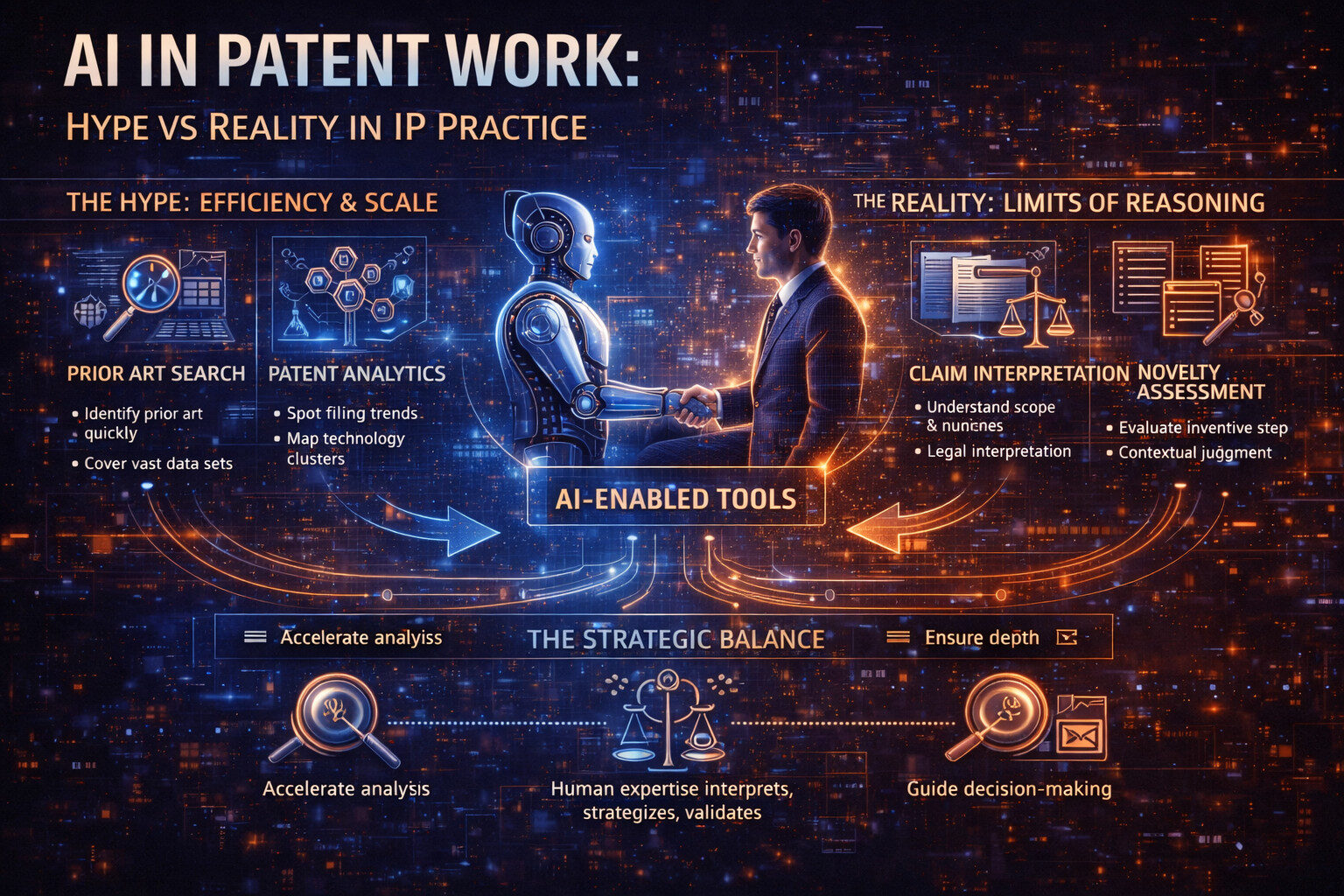
AI in Patent Work: Hype vs Reality in IP Practice

Artificial intelligence has rapidly entered the world of intellectual property, promising to transform how patents are searched, analyzed, drafted, and even litigated. From automated prior art searches to AI-assisted claim drafting, the narrative is compelling: faster workflows, deeper insights, and reduced human effort.
But beneath this momentum lies an important question—is AI truly ready to handle the complexity of patent work, or are expectations outpacing reality?
As adoption accelerates across law firms, corporates, and IP service providers, it becomes critical to separate what AI can actually do today from what it is often assumed to do.
Understanding the Hype: Why AI is Gaining Traction in IP
The appeal of AI in patent workflows is easy to understand.
Patent work involves handling vast amounts of data—technical documents, prior art references, prosecution histories, and legal arguments. AI, particularly machine learning and natural language processing, is well-suited to process and organize such information at scale.
This has led to rapid adoption in areas such as:
- Prior art search and document retrieval
- Patent classification and clustering
- Portfolio analysis and trend identification
In these contexts, AI delivers clear value by improving speed, consistency, and coverage. Tasks that once took days can now be completed in hours, if not minutes.
However, these strengths are primarily rooted in data processing and pattern recognition—not deep reasoning.
Where AI Works: Efficiency, Scale, and Pattern Recognition
At its current stage, AI excels in augmenting repetitive and data-intensive tasks.
For example, in prior art searches, AI can:
- Scan large patent databases efficiently
- Identify semantically relevant documents
- Surface hidden connections across technical domains
Similarly, in patent analytics, AI can uncover trends that would be difficult to detect manually—such as emerging technology clusters or competitive filing patterns.
In these applications, AI acts as a force multiplier—enhancing human capabilities rather than replacing them.
The key advantage lies in its ability to handle scale. It can process thousands of documents simultaneously, ensuring broader coverage and reducing the risk of missing relevant information.
Where AI Falls Short: The Limits of Reasoning
Despite its strengths, AI faces significant limitations when it comes to complex patent reasoning.
Patent work is not just about finding information—it is about interpreting it within a legal and technical context. This includes:
- Understanding claim scope and nuances
- Evaluating inventive step and non-obviousness
- Crafting arguments during prosecution or litigation
These tasks require a combination of domain expertise, contextual judgment, and strategic thinking—areas where AI remains limited.
For instance, while an AI system may identify relevant prior art, determining whether that art anticipates or renders a claim obvious often requires nuanced analysis that goes beyond pattern matching.
Similarly, drafting claims is not just a linguistic exercise—it involves anticipating how competitors might design around the invention and how courts might interpret the language.
These are inherently human-driven processes.
Real-World Impact: Augmentation, Not Replacement
In practice, the role of AI in patent work is best understood as augmentation rather than automation.
IP professionals are increasingly integrating AI tools into their workflows, but not as standalone solutions. Instead, AI is used to:
- Accelerate initial analysis
- Provide broader data coverage
- Support decision-making
Human expertise remains central to:
- Interpreting results
- Making strategic decisions
- Ensuring legal robustness
This hybrid approach allows organizations to benefit from AI’s efficiency while maintaining the depth and accuracy required in patent work.
The Strategic Perspective: Integrating AI into IP Workflows
As AI tools become more sophisticated, the focus is shifting from adoption to integration.
Organizations are asking:
- How can AI be embedded into existing workflows?
- Which tasks should remain human-led?
- How can outputs be validated and verified?
Answering these questions requires a clear understanding of both the capabilities and limitations of AI.
From an IP strategy standpoint, the goal is not to replace expertise, but to enhance it—using AI to handle scale while reserving critical thinking for human professionals.
This balance is particularly important in high-stakes areas such as patent drafting, prosecution, and litigation, where errors can have significant consequences.
Looking Ahead: From Hype to Maturity
The trajectory of AI in patent work is undeniable—it will continue to evolve and play an increasingly important role in the IP ecosystem.
However, the transition from hype to maturity requires realistic expectations.
AI is not a substitute for expertise. It is a tool—powerful, scalable, and increasingly sophisticated—but still dependent on human judgment for meaningful application.
As the technology advances, we may see improvements in contextual understanding and reasoning. But for now, the most effective approach lies in combining AI capabilities with human insight.
In the end, the future of patent work will not be defined by AI alone. It will be shaped by how well we integrate intelligence—both artificial and human—into a cohesive, strategic workflow.
Because in a domain where precision and interpretation matter, the real advantage lies not in automation, but in augmented expertise.