

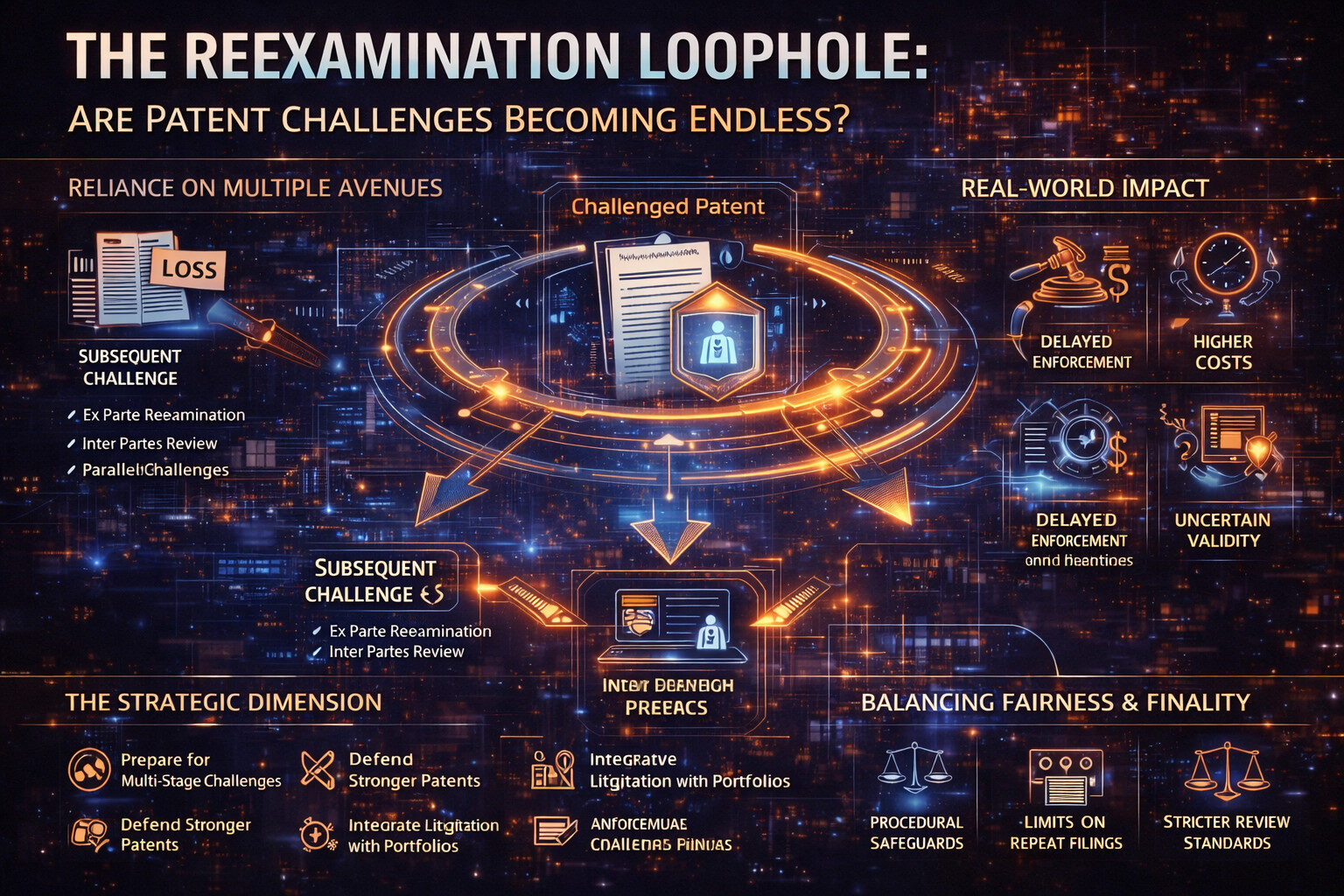
The Reexamination Loophole: Are Patent Challenges Becoming Endless?

In the world of patents, finality has always been a cornerstone of certainty. Once a patent is examined, challenged, and upheld, it is expected to provide a degree of stability—allowing innovators to move forward with confidence.
But what happens when that finality begins to erode?
Recent developments in patent practice suggest that challenges to granted patents are no longer confined to a single pathway. Instead, unsuccessful attempts to invalidate patents are increasingly being followed by alternative routes of reexamination, raising a critical question: are patent disputes becoming effectively endless?
Understanding the Shift: From One Challenge to Many
Traditionally, patent systems have offered structured mechanisms for challenging granted patents—whether through post-grant opposition, inter partes review, or reexamination proceedings. These processes were designed to balance two objectives:
- Ensuring that only valid patents remain enforceable
- Providing a clear endpoint to disputes
However, the landscape is evolving.
In some cases, parties that fail in one type of challenge are initiating subsequent proceedings through different channels, effectively extending the lifecycle of a dispute. While each mechanism operates within legal boundaries, the cumulative effect can be a cycle of repeated challenges against the same patent.
This shift is not merely procedural—it changes how patent certainty is perceived and managed.
How It Works: Navigating Multiple Avenues of Attack
Modern patent systems often include multiple pathways for review, each with distinct rules and standards.
For example, a patent may first be challenged through a post-grant review process. If that effort is unsuccessful, the same or related parties may pursue:
- Ex parte reexamination based on new prior art
- Inter partes review under different claim interpretations
- Parallel challenges in different jurisdictions
Because these mechanisms operate independently, they can be used sequentially—even when earlier challenges have failed.
From a strategic standpoint, this creates an opportunity to reframe arguments, introduce new evidence, or exploit procedural differences across forums.
Real-World Impact: Uncertainty in Enforcement and Innovation
The growing use of multiple challenge pathways has tangible consequences for patent holders and the broader innovation ecosystem.
For patent owners, repeated challenges can:
- Increase legal costs and resource allocation
- Delay enforcement and commercialization efforts
- Create uncertainty around the strength of their IP
For competitors, these mechanisms provide additional opportunities to contest patents that may impact their operations.
At an ecosystem level, the implications are more nuanced. While robust review processes help maintain patent quality, excessive or repetitive challenges can undermine the predictability that patents are meant to provide.
This tension between quality control and finality is becoming a defining issue in modern IP systems.
The Strategic Dimension: Litigation as a Process, Not an Event
As reexamination pathways expand, patent disputes are increasingly being viewed as ongoing processes rather than discrete events.
Organizations are adapting their strategies accordingly:
- Preparing for multi-stage challenges from the outset
- Building stronger, more defensible patent claims
- Integrating litigation strategy with prosecution and portfolio development
In some cases, companies are also leveraging these mechanisms offensively—using repeated challenges as a way to delay competitors or create negotiation leverage.
This evolution reflects a broader shift in how IP is managed: from static protection to dynamic strategy.
The IP Perspective: Balancing Fairness and Finality
At the heart of this issue lies a fundamental question: how should patent systems balance the need for thorough review with the need for closure?
On one hand, allowing multiple avenues of challenge ensures that weak or invalid patents can be identified and addressed. On the other hand, the absence of clear limits can lead to prolonged disputes and strategic misuse.
Policymakers and courts are increasingly being called upon to address this balance—whether through procedural safeguards, limits on repeated filings, or stricter standards for initiating subsequent reviews.
For IP professionals, this evolving landscape underscores the importance of anticipating not just one challenge—but many.
Looking Ahead: Rethinking Patent Certainty
The rise of reexamination strategies signals a broader transformation in the patent ecosystem.
Finality, once considered a defining feature of patent rights, is becoming more fluid. In its place, a more dynamic—and at times uncertain—environment is emerging, where patents are continuously tested and defended.
For innovators, this means that securing a patent is no longer the end of the journey. It is the beginning of an ongoing process of validation, enforcement, and strategic positioning.
In the years ahead, the systems that govern patent challenges will play a critical role in shaping how innovation is protected—and how confidently it can be pursued.
Because in a world where challenges can be repeated, the true strength of a patent may not lie in its grant—but in its ability to withstand what comes after.