

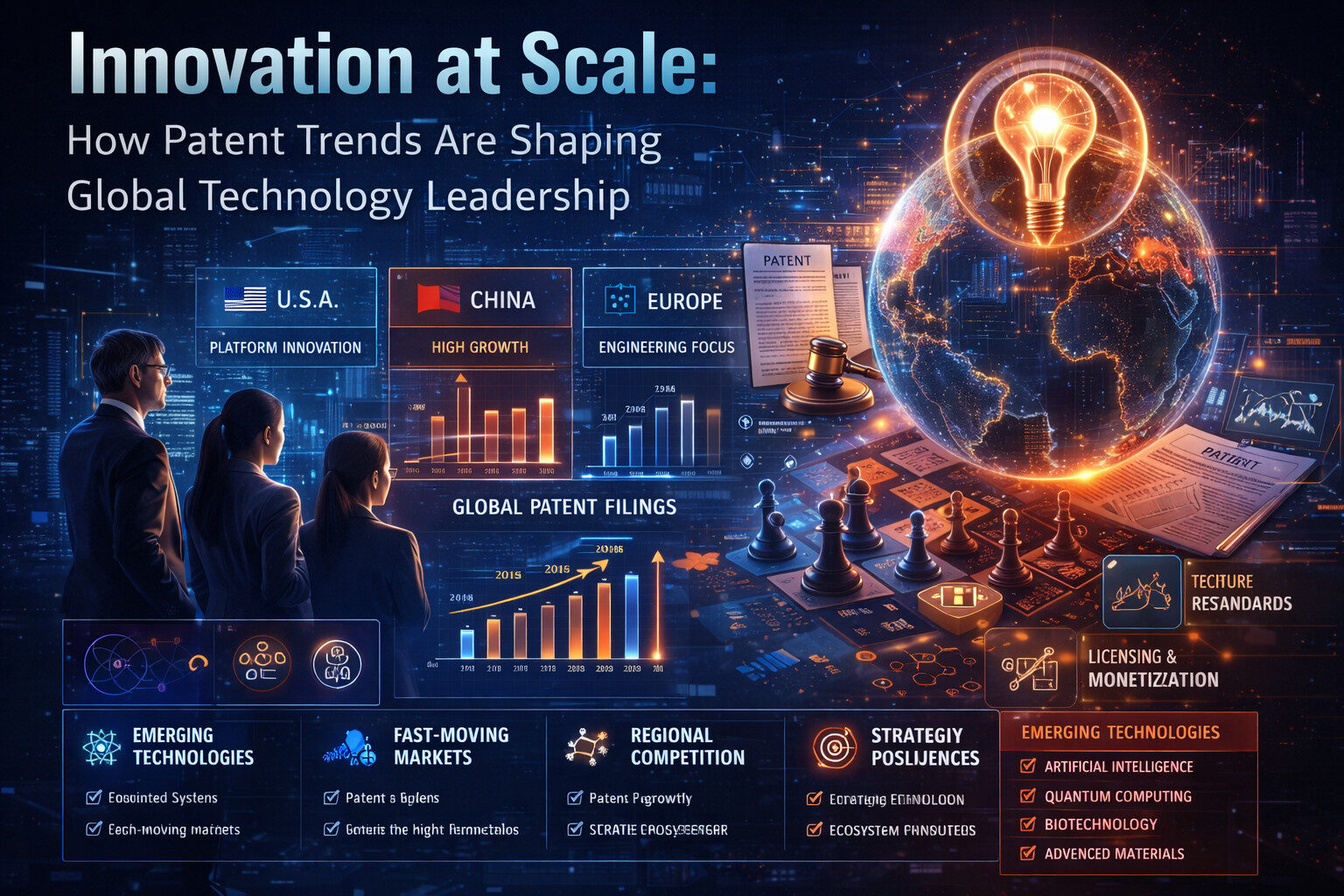
Innovation at Scale: How Patent Trends Are Shaping Global Technology Leadership

Innovation has always been a marker of progress—but in today’s interconnected world, it has also become a measure of power. Nations and corporations are no longer competing solely on products or services; they are competing on who leads the innovation pipeline itself.
At the center of this competition lies an often-overlooked indicator: patent trends.
Patent filings, once viewed as legal formalities, have evolved into strategic signals. They reveal where innovation is happening, who is driving it, and how future technological leadership is likely to be distributed. In many ways, patents are no longer just protecting innovation—they are actively shaping it.
Reading Between the Lines: What Patent Trends Reveal
Every patent filing represents more than a technical invention—it reflects intent, investment, and direction.
When analyzed collectively, patent data offers insights into:
- Emerging technology domains gaining traction
- Shifts in research and development priorities
- Competitive positioning across industries and regions
For example, a surge in filings related to artificial intelligence, renewable energy, or biotechnology often indicates where future growth and disruption are expected.
Unlike market reports or forecasts, patent trends provide a forward-looking view—capturing innovation at its earliest stages, before it fully reaches commercialization.
The Global Landscape: Who Is Leading the Race?
The competition for technological leadership is increasingly global.
Major economies such as the United States, China, and members of the European Union continue to dominate patent filings across key domains. Each region brings its own strengths:
- The United States excels in software, AI, and platform-driven innovation
- China demonstrates rapid growth in filings, particularly in emerging and applied technologies
- Europe maintains strong contributions in engineering, sustainability, and industrial systems
At the same time, other regions—including India, South Korea, and Japan—are playing increasingly important roles, contributing to a more distributed and dynamic innovation ecosystem.
This global diversity is accelerating progress, but it is also intensifying competition. Leadership is no longer defined by a single dominant player—it is shaped by who can innovate consistently and protect effectively across markets.
How It Works: From Filing to Influence
The impact of patents extends far beyond protection—they influence how technologies evolve and scale.
Organizations that build strong patent portfolios can:
- Set technical standards within industries
- Shape the direction of future research
- Control access to critical technologies through licensing
In some cases, early patents on foundational technologies become cornerstones for entire ecosystems. Subsequent innovations must either build upon or work around these patents, giving the original holders significant leverage.
This is particularly evident in fast-moving fields like AI, telecommunications, and healthcare, where foundational patents can define how technologies are implemented globally.
Industry Implications: Strategy Over Volume
While the number of patents filed is an important metric, quality and strategy matter more than quantity.
Companies are increasingly focusing on:
- Filing patents that cover core innovations rather than incremental improvements
- Building interconnected portfolios that reinforce each other
- Aligning IP strategy with long-term business objectives
This strategic approach allows organizations to create defensible positions in competitive markets. It also enables them to monetize their innovations through licensing, partnerships, and cross-licensing agreements.
In this context, patents are no longer isolated assets—they are integral components of broader business and innovation strategies.
The Role of Emerging Technologies
Emerging technologies are playing a significant role in shaping patent trends.
Fields such as artificial intelligence, quantum computing, advanced materials, and biotechnology are witnessing rapid growth in filings. These areas are not only technologically complex but also highly competitive, attracting investments from both private and public sectors.
As these technologies mature, patent landscapes are becoming increasingly dense. Navigating these landscapes requires not only technical expertise but also a deep understanding of IP dynamics.
For innovators, this means that success depends on both creating new technologies and strategically positioning them within existing patent ecosystems.
Looking Ahead: Leadership Through Innovation and Protection
The relationship between innovation and patents is evolving. Patents are no longer just a byproduct of innovation—they are a driving force behind it.
As organizations and nations continue to invest in research and development, patent trends will play a critical role in determining:
- Which technologies gain traction
- Who controls key markets
- How innovation is shared or restricted
For those looking to lead, the path forward is clear. It is not enough to innovate at scale—innovation must be strategically protected, globally positioned, and continuously evolved.
In the end, technological leadership will belong to those who not only create the future—but also secure their place within it.