

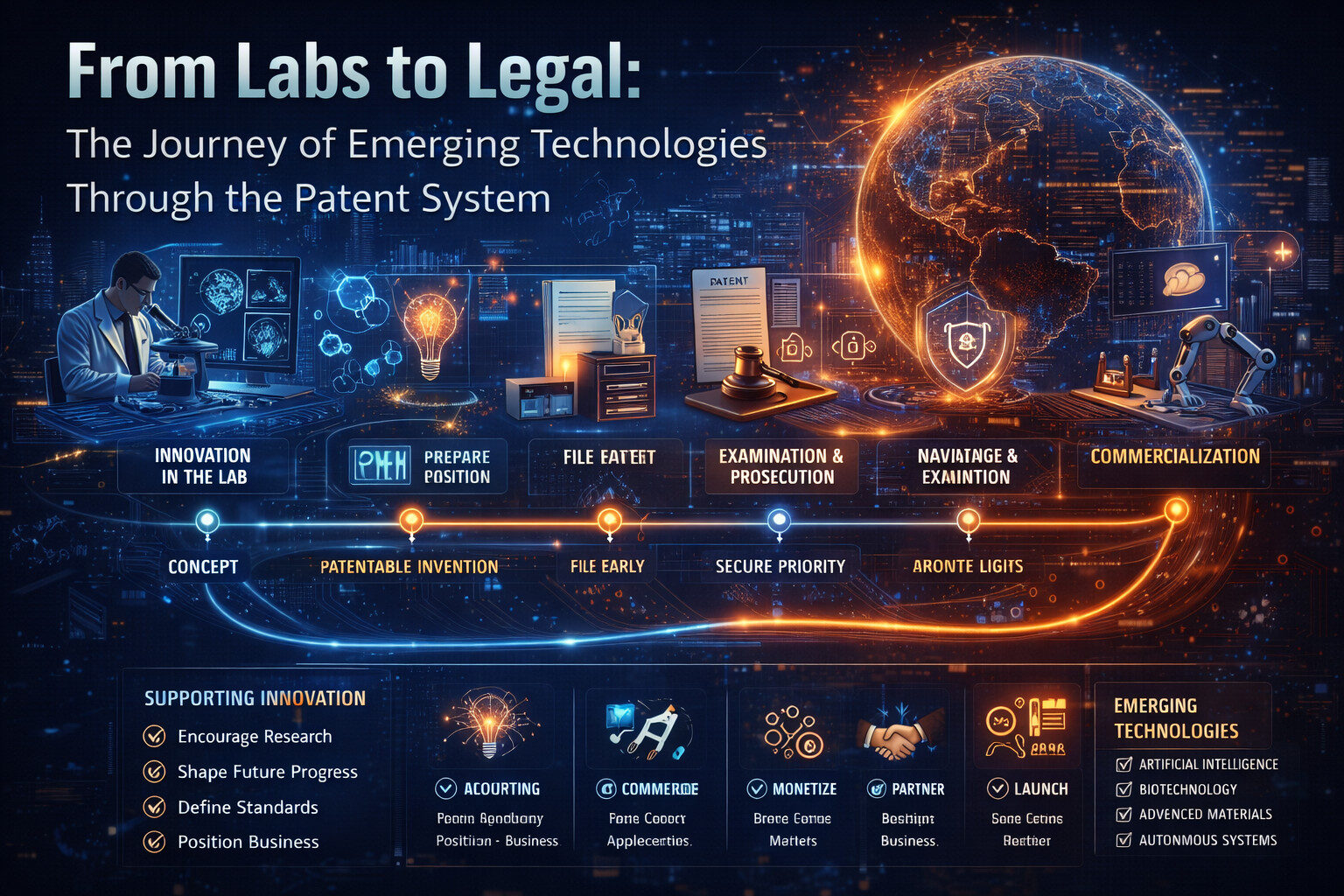
From Labs to Legal: The Journey of Emerging Technologies Through the Patent System

Every breakthrough technology begins with an idea—often in a research lab, a university setting, or within the R&D division of a forward-thinking company. In its earliest form, that idea is raw, experimental, and uncertain. But as it evolves, it follows a path that is just as critical as the innovation itself: the journey through the patent system.
This journey—from concept to protection—is what transforms innovation into a strategic asset. It is where science meets law, and where technical ingenuity is shaped into something that can be owned, defended, and commercialized.
The Starting Point: Innovation in the Lab
The lifecycle of a patented technology typically begins in an environment driven by curiosity and experimentation.
Researchers identify a problem, explore potential solutions, and gradually refine their approach through testing and iteration. At this stage, the focus is purely on technical feasibility and performance.
However, not every innovation is patentable. For an idea to qualify, it must meet key criteria such as novelty, non-obviousness, and industrial applicability. This means that even at the early stages, innovators must begin thinking about how their work differs from existing technologies.
Increasingly, organizations are integrating IP considerations into the research phase itself—ensuring that promising innovations are identified and documented before they are publicly disclosed.
Translating Innovation into a Patentable Invention
One of the most critical steps in the journey is translating a technical concept into a form that can be protected legally.
This involves:
- Clearly defining the invention
- Identifying its unique features
- Framing it in a way that highlights its technical contribution
At this stage, collaboration between technical experts and IP professionals becomes essential. While researchers understand the science, patent strategists understand how to position that science within the legal framework.
The goal is not just to describe the invention, but to claim it effectively—ensuring that the scope of protection is both meaningful and enforceable.
The Filing Process: Securing Priority
Once the invention is defined, the next step is filing a patent application.
This establishes a priority date, which is crucial in determining ownership rights. In fast-moving fields such as artificial intelligence, biotechnology, and advanced materials, being first to file can provide a significant advantage.
The filing process typically involves:
- Drafting a detailed specification
- Defining claims that outline the scope of protection
- Submitting the application to relevant patent offices
Many organizations adopt a global approach, filing in multiple jurisdictions to ensure broad protection. This requires careful planning, as each region has its own legal requirements and timelines.
Examination and Prosecution: Navigating the System
After filing, the application enters the examination phase.
Patent examiners review the application to determine whether it meets the necessary criteria. This often leads to a process known as prosecution, where applicants respond to objections, amend claims, and clarify aspects of the invention.
This phase can be complex and time-consuming. It requires not only a deep understanding of the invention but also strategic thinking to balance broad protection with compliance.
For emerging technologies, challenges can be even greater. Concepts such as AI algorithms or software-based innovations may face additional scrutiny, particularly around patent eligibility.
From Protection to Commercialization
Once granted, a patent becomes a powerful tool.
It provides the holder with exclusive rights to use, license, or commercialize the invention. This can open up multiple pathways:
- Bringing products to market
- Licensing technology to other companies
- Forming partnerships or joint ventures
In many cases, patents also play a role in attracting investment. A strong IP portfolio signals credibility and reduces risk for investors, particularly in technology-driven sectors.
At this stage, the focus shifts from protection to value creation—leveraging the patent to maximize its commercial potential.
The Broader Impact: Shaping Innovation Ecosystems
The journey of a technology through the patent system does not occur in isolation. It has broader implications for the innovation ecosystem.
Patents can:
- Encourage further research by disclosing technical details
- Influence the direction of future innovation
- Create competitive dynamics within industries
At the same time, they can also introduce challenges, such as overlapping rights or barriers to entry. Balancing protection with accessibility remains an ongoing consideration for policymakers and industry stakeholders.
Looking Ahead: Integrating Innovation and IP Strategy
As technologies become more complex and interconnected, the relationship between innovation and IP will continue to evolve.
Organizations are increasingly recognizing that success depends not only on developing breakthrough technologies, but also on navigating the patent system effectively. This requires early planning, cross-functional collaboration, and a strategic approach to protection.
In the end, the journey from lab to legal is not just a procedural step—it is a defining phase in the lifecycle of innovation. It determines how ideas are transformed into assets, how they are positioned in the market, and how they shape the future.
Because in today’s innovation landscape, creating something new is only the beginning. Ensuring it is protected—and strategically leveraged—is what truly defines its impact.