

Invisible Interfaces: Designing the Next Generation of Human-Tech Interaction

For decades, interacting with technology has meant adapting to screens, buttons, and defined input methods. From keyboards and touchscreens to voice assistants, each evolution has brought us closer to seamless interaction—but the interface has always remained visible.
Now, that paradigm is beginning to shift.
What if the most advanced interfaces are the ones you never notice? As emerging technologies redefine how humans interact with machines, we are moving toward a future where interfaces become intuitive, ambient, and almost invisible—blending effortlessly into our daily lives.
Understanding Invisible Interfaces
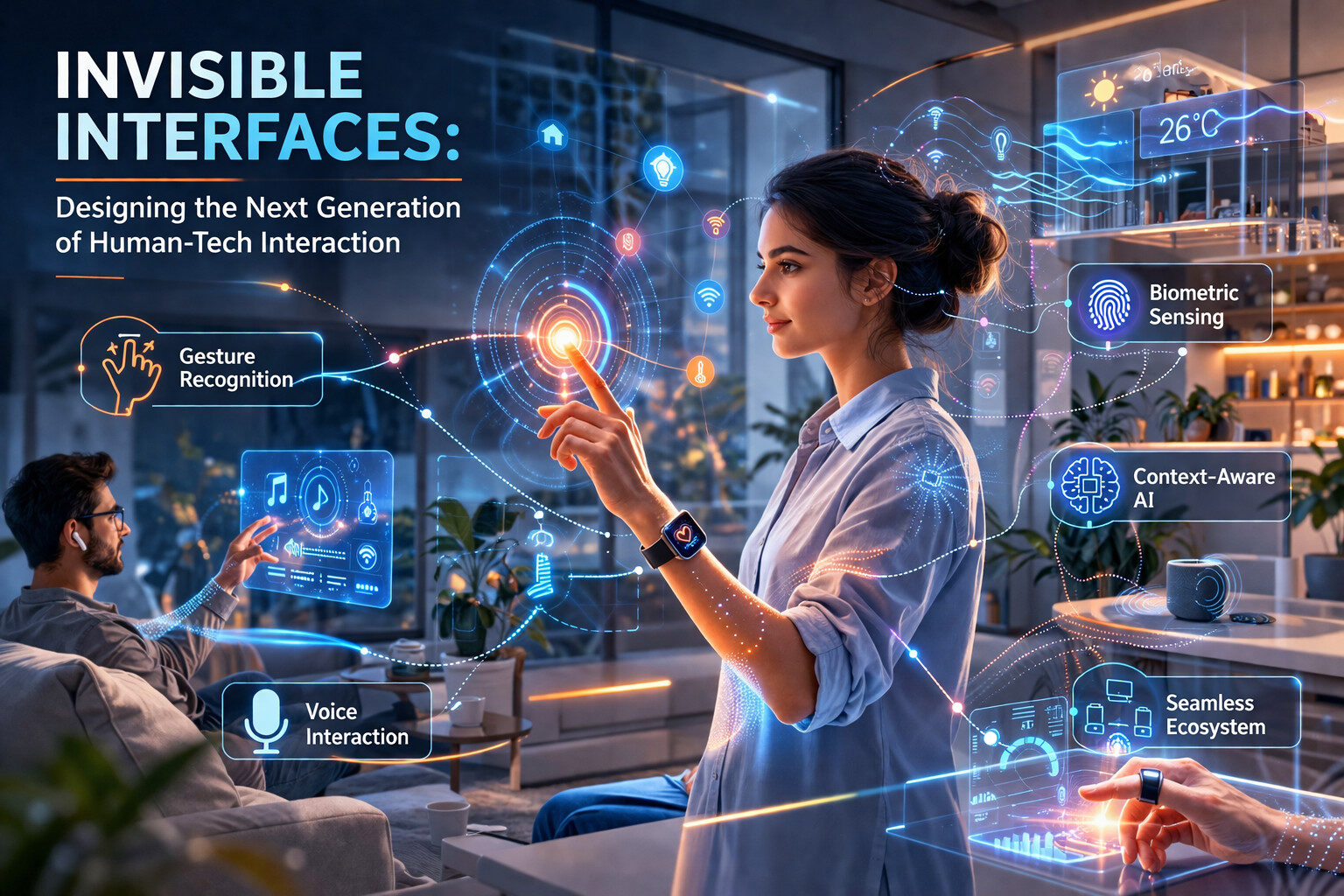
Invisible interfaces refer to systems where interaction happens naturally, without the need for explicit physical controls or traditional visual elements. Instead of tapping a screen or pressing a button, users engage with technology through gestures, voice, biometrics, or even contextual cues.
This shift is driven by a simple goal: reducing friction between humans and machines.
Rather than requiring users to learn how to operate devices, invisible interfaces allow devices to understand users—adapting to behavior, environment, and intent. The result is a more fluid and human-centric interaction model.
How It Works: Intelligence Behind the Interface
At the core of invisible interfaces lies a combination of advanced sensing technologies and artificial intelligence.
Modern systems integrate multiple input layers—such as motion sensors, microphones, cameras, and biometric detectors—to continuously capture contextual data. This data is then processed using AI models trained to interpret human behavior, gestures, and speech patterns.
For example, a wearable device might detect subtle hand movements to execute commands, while simultaneously analyzing voice input and environmental context to refine its response. In more advanced setups, systems can anticipate user needs based on historical behavior, reducing the need for explicit commands altogether.
Importantly, these interactions are not isolated. Invisible interfaces often function as part of a connected ecosystem, where devices communicate with each other to deliver a unified experience.
Real-World Applications: From Devices to Environments
The emergence of invisible interfaces is already reshaping multiple domains.
In consumer electronics, wearables are moving beyond touch-based controls toward gesture-driven and voice-enabled interactions. This is particularly relevant for compact devices where screen space is limited, making traditional interfaces less practical.
In smart environments, invisible interfaces enable ambient intelligence. Lighting systems, climate controls, and entertainment setups can respond automatically to user presence, preferences, and behavior—creating personalized spaces without manual intervention.
Healthcare is another area witnessing early adoption. Assistive devices equipped with invisible interfaces can monitor patients, detect anomalies, and respond to changes without requiring active user input. This is especially valuable for elderly care and continuous health monitoring.
Even in industrial settings, workers can interact with machines through gestures or voice commands, reducing reliance on physical controls and improving operational efficiency.
The Design Challenge: Making Technology Disappear
Designing invisible interfaces is not just a technological challenge—it is a fundamentally different design philosophy.
Traditional interface design focuses on visual clarity and usability. In contrast, invisible interfaces demand a deeper understanding of human behavior, context, and intent. Designers must anticipate how users naturally interact with their environment and build systems that align with those patterns.
This introduces new complexities. Systems must be highly accurate in interpreting inputs, as errors can disrupt the seamless experience. Privacy and data security also become critical concerns, given the continuous collection and analysis of user data.
From an innovation standpoint, this shift is driving significant patent activity. Companies are seeking to protect novel interaction methods, sensor integrations, and AI-driven interpretation models. The competitive landscape is expanding beyond hardware to include interaction paradigms themselves—turning user experience into a key area of intellectual property.
Industry and IP Implications
As invisible interfaces gain traction, they are redefining how value is created and protected in technology ecosystems.
Patents are increasingly focusing on:
- Multi-modal interaction systems combining gesture, voice, and context
- Sensor fusion techniques for improved accuracy
- AI models that interpret user intent in real time
This creates a layered IP landscape where innovation is not limited to devices, but extends to how users interact with them.
For businesses, this means that differentiation will depend not only on product capabilities but also on the sophistication of interaction design. Companies that can deliver seamless, intuitive experiences—while securing strong IP protection—will be better positioned in this evolving market.
Looking Ahead: A World Without Interfaces
The journey toward invisible interfaces represents a broader shift in how we think about technology. Instead of tools we actively use, devices are becoming extensions of our environment—responsive, adaptive, and increasingly autonomous.
In this future, interaction will feel less like operating a machine and more like engaging with an intelligent system that understands context, intent, and behavior.
While challenges remain—particularly around accuracy, privacy, and standardization—the direction is clear. The most successful technologies will not demand attention; they will quietly integrate into our lives, enhancing experiences without disrupting them.
In the end, the goal of interface design may not be to improve what we see—but to eliminate the need to see it at all.