

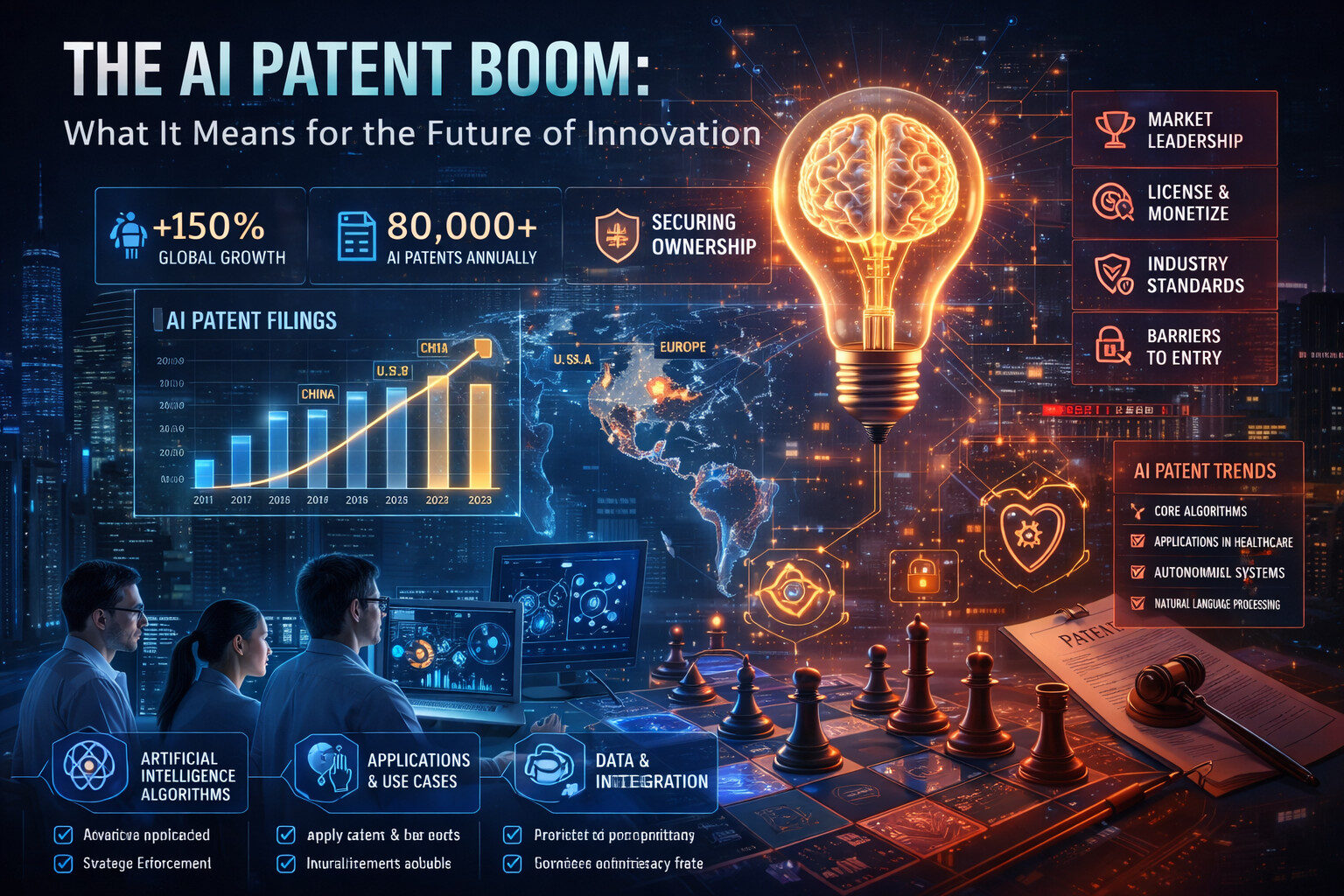
The AI Patent Boom: What It Means for the Future of Innovation

Artificial intelligence is no longer confined to research labs or experimental applications—it is rapidly becoming the foundation of modern innovation. From healthcare and finance to manufacturing and consumer technology, AI is reshaping how industries operate and compete.
Alongside this technological surge, another trend is quietly accelerating: a dramatic rise in AI-related patent filings. Across jurisdictions and industries, organizations are racing not only to develop AI capabilities, but to secure ownership over them.
This growing wave of patent activity is more than a statistical trend—it is a signal of how the future of innovation will be structured, controlled, and commercialized.
Understanding the Surge: Why AI Patents Are Rising
The increase in AI patent filings is driven by a convergence of factors.
First, AI technologies have reached a level of maturity where they are no longer theoretical—they are commercially viable. Companies are embedding AI into products and services at scale, making it essential to protect these innovations.
Second, the competitive landscape is intensifying. Technology giants, startups, and research institutions are all working on similar problems, from natural language processing to predictive analytics. In such an environment, securing patents becomes a way to establish differentiation and prevent competitors from replicating key capabilities.
Third, governments and policymakers are recognizing the strategic importance of AI. Many countries are encouraging innovation through funding, incentives, and supportive IP frameworks—further accelerating patent activity.
Together, these factors have created a global race to capture value in AI through intellectual property.
What Is Being Patented?
AI patents are not limited to a single type of invention. Instead, they span a wide range of technological layers.
Key areas of patent activity include:
- Core Algorithms and Models
Innovations in machine learning architectures, training techniques, and optimization methods - Application-Specific Implementations
AI systems tailored for domains such as healthcare diagnostics, autonomous vehicles, or financial analytics - System Architectures
Integrating AI into larger platforms, including cloud-based systems and edge computing environments - Data Processing and Management
Methods for collecting, cleaning, and utilizing data to improve AI performance
This diversity reflects the versatility of AI—and the many ways in which it can be applied to solve real-world problems.
The Strategic Role of Patents in AI
In the context of AI, patents are not just about protection—they are about strategic positioning.
Companies are using patents to:
- Establish leadership in emerging domains
- Create barriers to entry for competitors
- Enable licensing and revenue generation
- Influence industry standards
In some cases, early patents on foundational technologies can shape entire ecosystems. For example, securing rights over key methods in AI-driven diagnostics or autonomous systems can give companies long-term advantages as these technologies scale.
At the same time, the fast pace of AI development means that patent strategies must be dynamic. Organizations are continuously refining their portfolios to keep up with evolving technologies and market needs.
Challenges in the AI Patent Landscape
Despite the surge in filings, patenting AI is not without challenges.
One of the primary issues is patent eligibility. In many jurisdictions, abstract ideas and mathematical methods are not patentable. As a result, AI-related inventions must be framed in terms of practical applications and technical contributions.
Another challenge is the overlap of innovations. With many organizations working on similar problems, distinguishing one invention from another can be difficult. This increases the risk of disputes and requires careful claim drafting.
Additionally, the role of data introduces complexity. While algorithms can be patented, the datasets used to train them are often protected through trade secrets, creating a hybrid IP landscape.
These challenges highlight the need for a nuanced and well-structured approach to AI patenting.
The Global Dimension: A Race Without Borders
The AI patent boom is inherently global.
Countries such as the United States, China, and members of the European Union are leading in terms of filings, but innovation is emerging from across the world. Each jurisdiction brings its own regulatory framework, strategic priorities, and competitive dynamics.
For companies, this means that patent strategy must extend beyond a single market. Filing decisions, enforcement strategies, and portfolio management all need to be aligned with global objectives.
At the same time, this international competition is driving rapid progress. As nations and organizations compete to lead in AI, the pace of innovation continues to accelerate.
Looking Ahead: Shaping the Future Through IP
The rise in AI patent filings is more than a reflection of technological growth—it is a blueprint for the future of innovation.
As AI becomes increasingly embedded in every aspect of life, the ownership of key technologies will play a defining role in determining who leads, who follows, and how value is distributed.
For innovators, the message is clear: developing advanced AI systems is only part of the journey. Equally important is securing the intellectual property that protects and positions those innovations in the market.
In the years ahead, the companies and countries that successfully combine technological excellence with strategic IP management will be best positioned to shape the future.
Because in the age of AI, innovation does not just belong to those who create—it belongs to those who claim it.